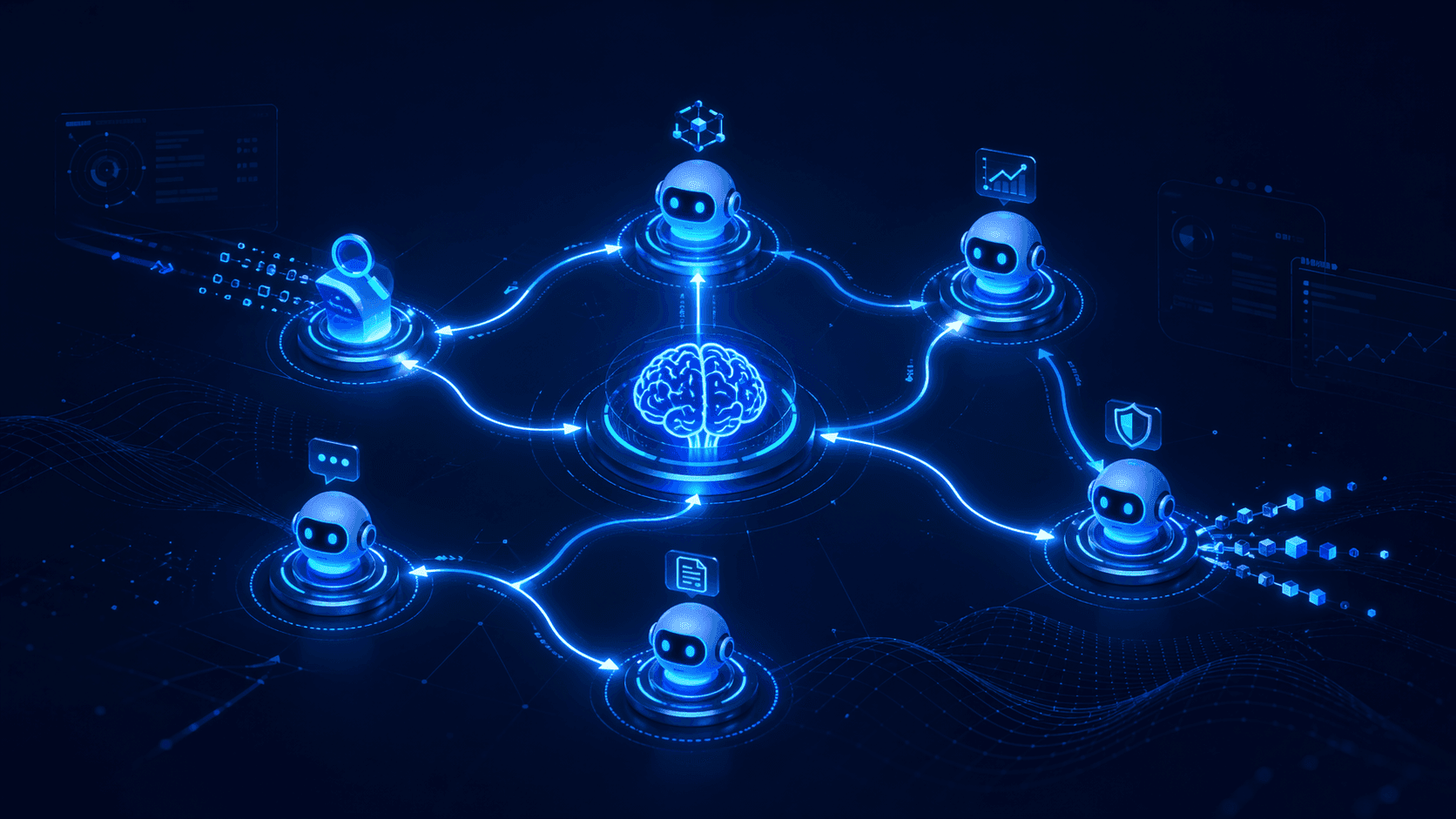
Artificial intelligence has moved far beyond simple chatbots and recommendation engines. Today, a new generation of AI systems — called agentic AI — can reason through problems, take actions, and complete complex multi-step tasks with minimal human input. For businesses, this shift is not incremental. It is transformative.
In this guide, we break down what agentic AI is, how AI agents actually work, and why forward-thinking companies are already building agentic systems to automate workflows, reduce operational costs, and unlock new capabilities.
What Is Agentic AI?
Agentic AI refers to AI systems that can act autonomously to achieve goals. Unlike traditional AI models that respond to a single prompt and stop, agentic AI systems are designed to plan, reason, use tools, make decisions, and execute sequences of actions — all in pursuit of a broader objective.
The key difference lies in agency. A standard large language model (LLM) answers your question. An AI agent reads the question, decides what information it needs, calls the right tools to gather it, synthesises a response, and then takes follow-up actions — all without you directing each step.
This capability is built on a combination of large language models, tool access (APIs, databases, web search, code execution), memory systems, and orchestration frameworks like LangChain, AutoGen, or custom-built pipelines.
How Do AI Agents Work?
A well-designed AI agent follows a cycle: perceive, plan, act, observe, repeat. Here is what each phase means in practice:
- Perceive: The agent receives input — a user instruction, a system trigger, or an incoming data event.
- Plan: The agent uses an LLM to reason about the task, break it into sub-tasks, and decide what actions to take.
- Act: The agent calls tools — searching the web, querying a database, sending an API request, writing code, or interacting with a UI.
- Observe: The agent reads the result of its actions and updates its plan accordingly.
- Repeat: The loop continues until the goal is achieved or a stop condition is met.
More sophisticated agentic systems involve multiple agents working in parallel or in a defined hierarchy — a manager agent delegating sub-tasks to specialised worker agents, each with its own tools and context window.
Why Agentic AI Matters for Business
The business case for agentic AI is grounded in one core reality: most knowledge work is repetitive, multi-step, and rule-governed. Agentic AI systems can handle exactly this kind of work — continuously, accurately, and at scale.
Here are the areas where agentic AI is delivering real business value today:
Workflow Automation at Scale
Traditional automation handles simple, linear workflows. Agentic AI handles complex workflows that branch, adapt, and respond to real-world conditions. A customer support agent can triage tickets, look up account data, draft responses, escalate edge cases, and update CRM records — all without human involvement at each step.
Research and Data Analysis
AI agents can be tasked with open-ended research objectives. They retrieve documents, analyse datasets, cross-reference sources, identify patterns, and produce structured reports — compressing hours of analyst work into minutes.
Software Development Assistance
Agentic coding systems can write code, run tests, debug failures, and iterate on solutions. While they do not replace skilled developers, they dramatically accelerate development cycles for well-defined tasks.
Sales and Lead Qualification
Sales agents can research prospects, personalise outreach, follow up on leads, and update pipeline data — reducing the manual overhead that slows most sales teams down.
Operations and Process Management
Agentic AI can monitor operational metrics, detect anomalies, trigger alerts, and initiate defined response playbooks — acting as a continuous operations layer that never sleeps.
The Technology Behind Agentic AI
Building reliable agentic AI systems requires more than a powerful LLM. Several components work together:
- Foundation Models: GPT-4, Claude, LLaMA, or Mistral provide the reasoning core.
- Tool Use / Function Calling: Models are given access to defined functions — APIs, database queries, search tools — which they can call when needed.
- Memory Systems: Short-term context windows, long-term vector stores (like Pinecone or ChromaDB), and episodic memory allow agents to retain and retrieve relevant information.
- Orchestration Frameworks: LangChain, LangGraph, AutoGen, and CrewAI provide the scaffolding to define agent roles, coordinate multi-agent systems, and manage state.
- Evaluation and Safety Layers: Production agents require guardrails — output validation, human-in-the-loop escalation, rate limiting, and logging — to ensure reliability and prevent unintended actions.
Common Challenges in Agentic AI Deployment
Agentic systems are powerful but not plug-and-play. The most common challenges include:
- Reliability: Multi-step agent chains can fail unpredictably. Robust error handling and fallback strategies are essential.
- Latency: Agents that make many tool calls add latency to each interaction. Architectural choices around caching and parallel execution matter significantly.
- Hallucination: LLMs can generate plausible but incorrect information. RAG (Retrieval-Augmented Generation) and grounding strategies help reduce this risk.
- Security: Agents with tool access can potentially be manipulated through prompt injection. Careful scoping of permissions and output validation are non-negotiable.
- Cost Management: Frequent LLM calls at scale accumulate cost. Intelligent routing between smaller and larger models keeps costs manageable.
Is Agentic AI Right for Your Business?
Agentic AI delivers the highest return where work is high-volume, repetitive, knowledge-intensive, and currently dependent on skilled human time. If your business has any of the following, it is worth exploring what an agentic solution could do:
- Large volumes of customer queries or support tickets
- Complex internal approval and routing workflows
- Research, reporting, or data analysis tasks that consume analyst hours
- Sales, outreach, or relationship management workflows at scale
- Operations monitoring and incident response processes
The key is to start with a well-scoped problem, define clear success criteria, and build incrementally — rather than attempting to automate everything at once.
Building Agentic AI Systems with Savyasachi Infotech
At Savyasachi Infotech, we design and develop custom AI agents and agentic AI systems tailored to real business workflows. From single-purpose automation agents to multi-agent orchestration systems, we build solutions that integrate with your existing tools and data infrastructure.
Our AI development work spans LLM integration, RAG implementation, tool use and function calling, long-term memory systems, and production deployment on AWS, Google Cloud, and Azure. We work with OpenAI, Anthropic, LLaMA, Mistral, and locally deployed models — choosing the right stack for each use case based on performance, cost, and data privacy requirements.
If you are exploring what agentic AI could do for your business, book a consultation with our team and we will walk you through where the opportunity lies.
Key Metrics to Track When Deploying Agentic AI
Once an agentic AI system is live, measurement is essential to understand whether it is performing as expected and delivering value. Key metrics to track include task completion rate (what percentage of tasks the agent completes without human escalation), error rate and error type distribution, latency per task, cost per completed task (LLM API costs plus infrastructure), and human review rate over time (which should decrease as the agent improves).
Setting up dashboards that surface these metrics in near-real-time allows your team to identify regressions quickly, catch edge cases before they compound, and demonstrate ROI to stakeholders. Agentic AI systems that are not instrumented are difficult to trust and difficult to improve — measurement is foundational to the process of iterative improvement that makes these systems genuinely valuable over time.
Start Building Agentic AI for Your Business
Most businesses are still running workflows manually that could be handled autonomously by a well-designed AI agent. The gap between companies that automate and those that do not is widening — and it compounds every quarter.
At Savyasachi Infotech, we design and develop custom AI agents and agentic systems built around your specific workflows, tools, and data. We handle architecture, model selection, orchestration, security, and deployment — so you get a production-ready system, not a proof of concept.
Book a free consultation with our AI development team. We will map your highest-value automation opportunity and walk you through exactly what it would take to build it.