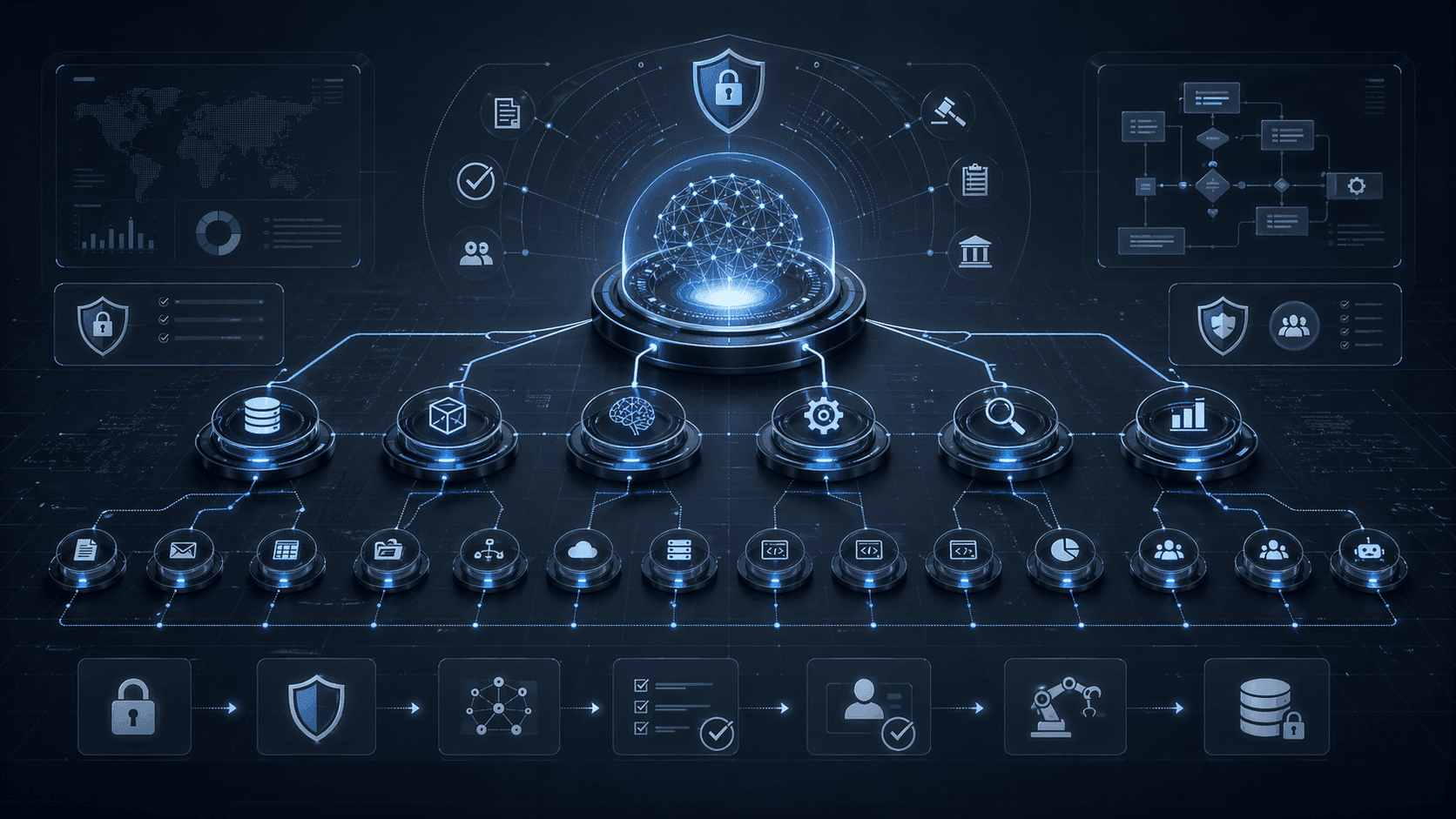
Enterprise operations are built on complex workflows - multi-step processes that cross systems, departments, and data sources, often requiring judgement calls that cannot be reduced to simple if-then rules. For years, these workflows were beyond the reach of automation. The AI agent development capabilities available today have changed that.
This guide covers what enterprise AI agents are, how to identify the right workflows to automate, how to architect reliable agent systems, and what it takes to deploy them successfully at enterprise scale.
What Makes Enterprise AI Agents Different
Consumer-facing AI agents - chatbots, personal assistants, recommendation engines - operate in relatively forgiving environments. Enterprise AI agents operate under different constraints:
- Data sensitivity: Enterprise data - financial records, customer information, proprietary research, personnel data - requires strict access controls and often cannot leave the organisation's infrastructure.
- System integration complexity: Enterprise agents need to interact with existing systems: CRMs, ERPs, HRIS platforms, data warehouses, internal APIs, and legacy databases - each with its own authentication, rate limits, and data model.
- Auditability and compliance: Enterprise environments require detailed logs of what an agent did, when, and on what basis - for compliance, auditing, and debugging.
- Reliability expectations: Enterprise processes cannot tolerate frequent failures or unexpected behaviour. Agents must be robust, predictable, and fail safely.
- Scale: Enterprise agents may process thousands of transactions per day, requiring performance and cost optimisation that consumer applications do not.
Identifying Enterprise Workflows for AI Agent Automation
The best enterprise AI agent opportunities are workflows that are:
Multi-Step and Cross-System
Workflows that require gathering information from multiple sources, applying business logic, and taking actions across multiple systems are the ones that benefit most from agentic AI. A human completing this workflow manually must context-switch between systems, remember intermediate results, and maintain the thread of the task across multiple sessions. An AI agent does this natively.
High-Volume and Relatively Consistent
High-volume processes justify the investment in agent development. If a process happens 500 times per week, automating it with an agent that handles 80% of cases fully and escalates 20% to humans delivers significant ROI. If it happens five times per week, the calculus is different.
Currently Bottlenecked by Human Availability
Processes that slow down because they are waiting for a human to be available - approvals, data lookups, report generation, triage decisions - are excellent agent candidates. Agents operate 24/7 and are not constrained by working hours or team capacity.
Structured in Outcome, if Not in Input
The input to an enterprise AI agent can be unstructured (an email, a voice recording, a uploaded document). What matters is that the desired output is well-defined. If you can clearly specify what a correctly completed version of the task looks like, you can build an agent that achieves it.
Architecting Enterprise AI Agents
Define the Agent's Scope and Permissions
Before writing a line of code, define precisely what the agent is allowed to do. What systems can it access? What data can it read? What actions can it take? What decisions does it make autonomously vs. escalate to humans? Scope creep in agent permissions is a security and reliability risk.
The principle of least privilege applies: the agent should have access to exactly the systems and data it needs for its task, and nothing more.
Design the Tool Set
Enterprise agents operate through a defined set of tools - functions the agent can call to interact with external systems. A procurement agent's tools might include: search purchase order database, query vendor records, check budget allocation, create purchase order draft, send notification to approver, update ERP record.
Each tool must be designed with clear input/output specifications, error handling, and appropriate authentication. The quality of the tool set determines the quality of the agent's capabilities.
Implement Robust Orchestration
Orchestration frameworks - LangGraph, AutoGen, CrewAI, or custom-built pipelines - manage the agent's execution: tracking state, managing the tool call loop, handling errors, and maintaining context across multi-step tasks. For enterprise use, the orchestration layer also needs to support:
- Persistent task state (so a multi-hour or multi-day task can be resumed if interrupted)
- Human-in-the-loop escalation (so the agent can pause and request human input when it encounters ambiguous situations)
- Detailed logging (every tool call, every decision, every output - timestamped and stored)
- Timeout and fallback handling (so stuck tasks fail safely rather than hanging indefinitely)
Handle Data Privacy and Security
For enterprise deployments handling sensitive data, the choice of underlying LLM matters. Options include:
- Cloud LLMs with data processing agreements: OpenAI, Anthropic, and Google Cloud all offer enterprise agreements with data privacy commitments. Suitable for many enterprise use cases.
- Locally deployed open-source models: LLaMA 3, Mistral, or Qwen deployed on-premises or in the organisation's private cloud. The data never leaves the organisation's infrastructure. More operational complexity, but maximum data control.
- Azure OpenAI Service: OpenAI models deployed in the enterprise's Azure tenancy. Data stays within the enterprise's Azure environment.
Evaluation and Quality Assurance
Enterprise AI agents require systematic evaluation before deployment. Unlike software that either works or does not, agents can produce outputs that are technically functional but qualitatively wrong - a subtly incorrect data extraction, a misdirected escalation, an action taken on the wrong record.
Effective evaluation includes:
- Regression testing on historical cases: Run the agent against documented historical examples of the workflow and verify that outputs match expected results.
- Edge case testing: Deliberately test with unusual, ambiguous, or malformed inputs to verify that the agent fails safely or escalates appropriately.
- Shadow deployment: Run the agent in parallel with the human process for a period, comparing agent outputs to human outputs without acting on the agent's results. Identify discrepancies and tune before going live.
- Ongoing monitoring: Track output quality metrics in production, with alerts when performance degrades and mechanisms for humans to flag incorrect agent outputs for review.
Change Management and Adoption
The technical deployment of an enterprise AI agent is often easier than the organisational change it requires. Employees whose workflows are being automated have legitimate questions about how their roles will change, and process owners need confidence that the agent performs reliably before they hand over responsibility.
Successful enterprise agent deployments invest in transparent communication about what the agent does, clear escalation paths when it encounters limitations, and a transition period where humans and the agent work in parallel before full handover.
Enterprise AI Agent Development with Savyasachi Infotech
At Savyasachi Infotech, we build AI agents for enterprise workflows - from scoping and tool design through orchestration, security architecture, testing, and deployment. We have implemented agentic systems using LangChain, LangGraph, OpenAI, Anthropic, and locally deployed LLaMA models across research, analytics, and operational automation use cases.
If you are evaluating AI agent development for a specific enterprise workflow, get in touch. We will help you assess feasibility, design the right architecture, and build a solution that operates reliably in your environment.
Measuring Agent Performance Over Time
Enterprise AI agent performance is not static. As the underlying LLM is updated, as your data changes, and as the volume and variety of inputs grows, agent performance can shift - sometimes improving, sometimes degrading in specific areas. Continuous monitoring is essential to maintaining the reliability that enterprise deployments require. Establish a regular evaluation cadence: weekly or monthly reviews of agent output samples, tracking of key performance metrics over time, and structured processes for collecting and acting on feedback from the humans who oversee the agent's work.
Treat your enterprise AI agent as a system that requires ongoing maintenance and improvement, not a one-time deployment. The organisations that build the strongest AI automation capabilities are those that invest in the operational infrastructure - monitoring, evaluation, feedback loops, and improvement cycles - that allows their agents to get better over time rather than plateau or degrade.
Ready to Deploy AI Agents Across Your Enterprise Workflows?
The window to build meaningful AI automation advantages is open now. Enterprises that identify, design, and deploy AI agents for their highest-value workflows in 2026 will have operational capabilities in 2027 and 2028 that competitors are still trying to build. Waiting is a strategic choice - it is just not a neutral one.
At Savyasachi Infotech, we build enterprise AI agents - from scoping and tool design through orchestration architecture, security review, testing, and deployment. We have delivered agentic systems using LangChain, LangGraph, OpenAI, Anthropic, and locally deployed LLaMA models. We understand the security, compliance, and reliability requirements that enterprise deployments demand.
Book a free consultation and bring your target workflow. We will evaluate it for agent suitability, design the right architecture for your environment, and give you a clear implementation roadmap.