TrackWeaving
Project Overview
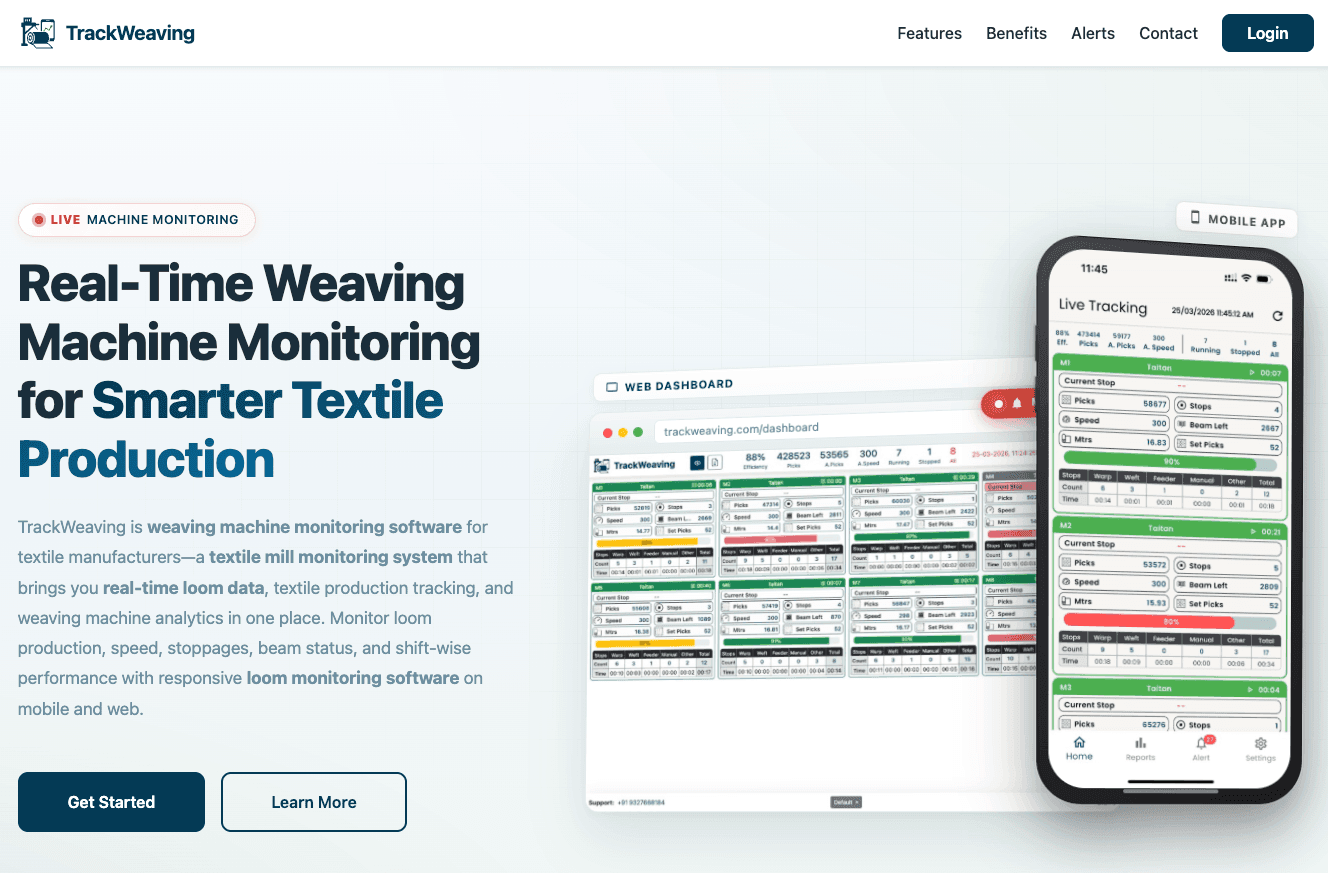
A real-time industrial monitoring platform built for textile manufacturing units to track machine performance, production activity, and operational insights across multiple looms. The platform gives factory managers live visibility into production status, machine health, and operational efficiency — enabling faster, data-driven decisions directly on the factory floor.
The Challenge
- Factory managers had no real-time visibility into individual loom performance or live production output.
- Manual tracking of machine activity was unreliable, slow, and produced inconsistent data across shifts.
- Production bottlenecks were identified too late for corrective action, resulting in avoidable downtime.
- Monitoring multiple looms simultaneously across a factory floor was operationally complex without a centralised system.
- No consolidated platform for tracking production targets, machine downtime, or shift-level efficiency metrics.
Our Solution
- Built a real-time data ingestion layer connecting to loom sensors and machine controllers for live performance feeds.
- Designed a centralised monitoring dashboard with live machine performance metrics, production output, and status indicators.
- Implemented per-loom tracking with individual status views, uptime monitoring, and automated anomaly detection.
- Built production reporting with shift-level summaries, downtime logs, and target vs. actual efficiency metrics.
- Designed for factory-floor use with a responsive interface accessible across desktops and production-floor devices.
Technical Approach
Industrial monitoring platforms live or die on data freshness. A dashboard that shows production status from five minutes ago is not a monitoring tool — it is a historical report. The first architectural decision on TrackWeaving was to build the data ingestion layer for true real-time throughput, with machine status updates reflected on the dashboard within seconds of a state change on the factory floor. This required a WebSocket-based communication layer between the backend and the frontend, with the backend maintaining persistent connections to sensor and controller data feeds and pushing updates to connected clients as they arrive.
The data model was designed around the loom as the primary entity, with a status state machine that tracks each loom through its operational states: running, idle, stopped, under maintenance, and error. Each state transition is timestamped and stored, building a complete operational history for every machine. This history is the foundation of the shift-level analytics — calculating uptime percentages, identifying recurring downtime patterns, and comparing actual production output against targets by shift, day, and machine. Anomaly detection runs over the incoming data stream, flagging state transitions that fall outside expected operating parameters and triggering alerts for factory managers to act on.
The factory-floor deployment context shaped the UI design significantly. Dashboard users are factory managers and supervisors working in an industrial environment — often on large screens mounted on the production floor, sometimes on tablets during floor walkthroughs. The interface was designed for glanceability: colour-coded machine status indicators that are readable at distance, alert banners that surface immediately without requiring navigation, and a layout that communicates the full factory floor status at a single view without scrolling. The responsive design ensures the same data is accessible on desktop and tablet without requiring a separate interface for each.
The platform was built with horizontal scalability in mind. The architecture supports adding new machine types, production lines, or factory locations without structural changes — each new machine type is defined through a configuration layer rather than requiring code changes. This makes TrackWeaving a foundation the client can grow into as their manufacturing operations expand, rather than a system tied to a specific snapshot of their current setup.
Key Features
Real-Time Machine Monitoring
Live tracking of individual loom performance, operating status, and production output with instant status updates across the full factory floor.
Multi-Loom Dashboard
Centralised dashboard providing a complete factory-floor view of all active and inactive looms in real time, in one place.
Production Activity Tracking
Shift-level and daily production summaries with target vs. actual metrics, downtime logs, and production trend reporting.
Operational Insights
Aggregated analytics on machine efficiency, production patterns, and performance trends to support management-level decision-making.
Anomaly Detection & Alerts
Automated alerts for performance deviations, unexpected downtime, and out-of-range machine activity to enable fast corrective action.
Technologies Used
Outcomes & Results
- Provided live production visibility across the full factory floor for the first time.
- Reduced reaction time to machine downtime and production bottlenecks significantly.
- Enabled data-driven shift planning and operational decision-making based on real production data.
- Built a scalable monitoring foundation ready to expand to additional machine types and production lines.
Want to Build Something Like This?
Let's discuss your project requirements and explore the right approach for your business.