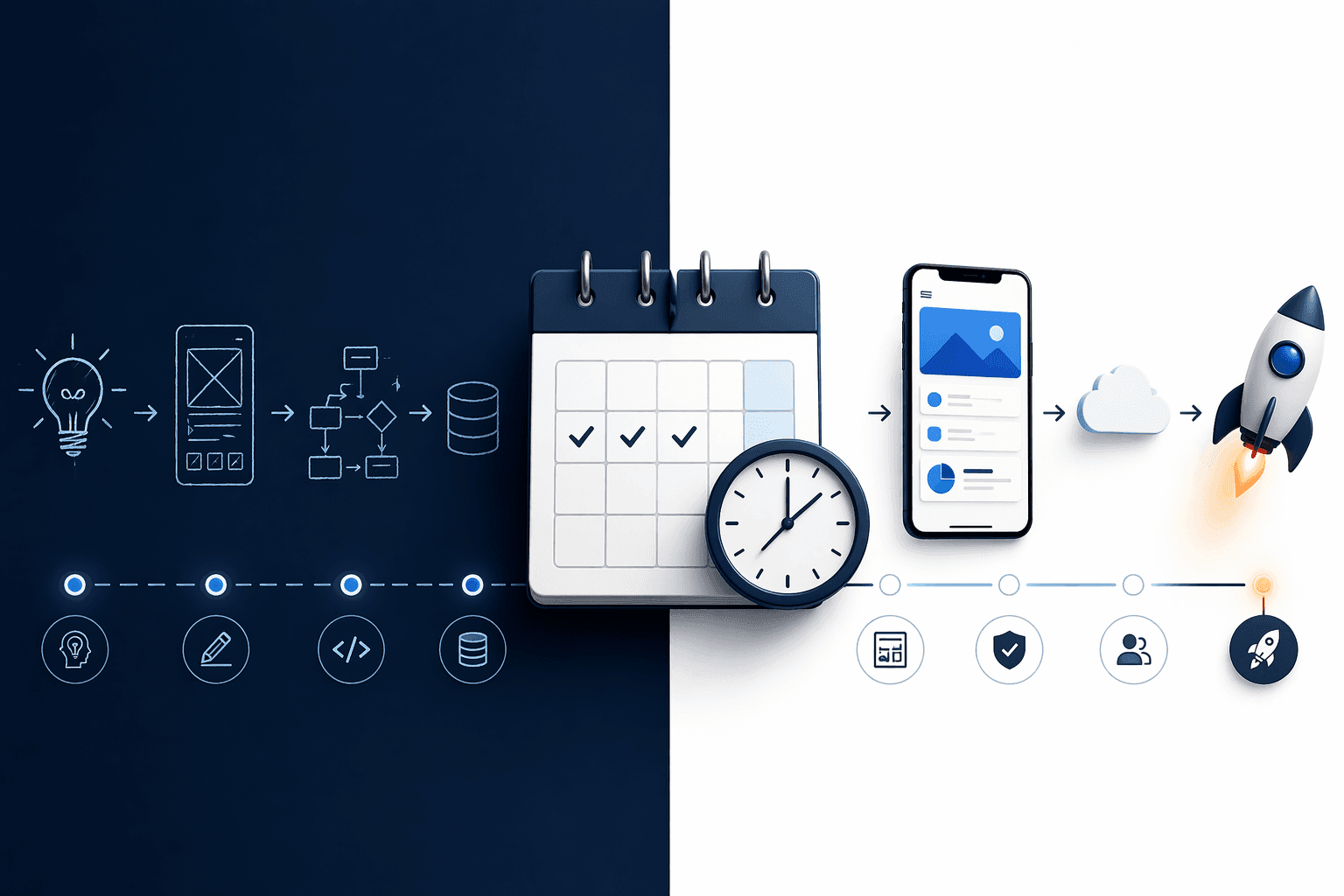
Eight weeks is enough time to go from a well-defined idea to a launched, real-user-facing digital product. It requires discipline - especially in what you choose not to build - but it is achievable, and the benefits of shipping quickly are enormous. Faster validation means faster learning, which means less money spent building in the wrong direction.
This guide walks through a practical 8-week plan for building a digital product MVP - covering the decisions, processes, and priorities that make the difference between a project that ships and one that drags on indefinitely.
The Prerequisites: Before Week 1
Eight weeks of development time only works if the team does not spend that time relitigating the product concept. Before the build clock starts, you need:
- A clearly defined problem: Not "we will build a platform for X" but "users who do X currently experience problem Y, and our product solves it by doing Z."
- A scoped feature set: A documented list of what version 1 includes and - critically - what it explicitly does not include. This list needs to be agreed and signed off before development starts.
- A defined target user: Specific enough that you can find 5-10 of them to test with. "Small business owners" is not specific enough. "Independent physiotherapy clinic owners in the UK with 1-3 therapists" is.
- Technology decisions: Stack, infrastructure, and team composition agreed and in place.
Week 1–2: Discovery, Architecture, and Design Foundations
Product and design work: Translate the scoped feature list into user flows and wireframes. Do not design every screen - design the critical paths: the onboarding flow, the core value-delivery flow, and the essential secondary interactions. Low-fidelity wireframes at this stage are fine; the goal is to validate the flow, not the aesthetics.
Technical architecture: Define the system architecture, database schema, API contracts, and infrastructure setup. Decisions made here - technology stack, data model, API design patterns - will be expensive to undo later. Invest the time to get them right, even under time pressure.
Development environment setup: Repository structure, CI/CD pipeline, staging environment, and development tooling in place by end of week 2. Any time spent debugging setup issues in week 5 is development time lost.
Key milestone: End of week 2 - wireframes signed off, API contracts defined, development environment live, sprint backlog planned for weeks 3-6.
Week 3–4: Core Backend and Data Layer
Weeks 3-4 focus on the backend foundation: authentication, core data models, and the primary API endpoints that the frontend and any integrations will depend on.
Authentication is non-negotiable in week 3 - everything downstream depends on knowing who the user is. Build it once, build it securely, and do not cut corners here.
Primary data models and their relationships should be established in week 3. Adding fields later is easy; restructuring core data relationships in week 7 is painful and risky.
By end of week 4, the critical API endpoints - the ones that the MVP's core user journey depends on - should be complete and testable. Frontend development in weeks 4-6 can then proceed against real API endpoints rather than mocked data.
Key milestone: End of week 4 - core API endpoints live on staging, authentication working, primary data models in place.
Week 4–6: Frontend Development (Parallel with Backend)
Frontend development begins in week 4, running in parallel with backend. Start with the core user journey - the flow that delivers the primary value proposition. Get that working end-to-end before touching secondary features.
A useful discipline: treat each screen as "done" only when it works with real data from the API, handles loading states, handles error states, and has been reviewed by at least one other team member. Screens that "work in happy path" but break on real data create debt that costs disproportionate time to fix in the last two weeks.
UI design in this phase should be finalised for the core screens. The visual layer is important - a poorly designed MVP will generate feedback about the design rather than the product concept, which wastes your validation signal. It does not need to be beautiful, but it needs to be functional and clear.
Key milestone: End of week 6 - full core user journey working end-to-end on staging, with real data, across all target devices and browsers.
Week 7: Integration, Testing, and Bug Fixing
Week 7 is for hardening, not for new features. Any feature not complete by start of week 7 should be cut from MVP scope or deferred to a post-launch iteration. Trying to add features in the last two weeks is how MVPs miss their launch dates.
Week 7 activities:
- End-to-end testing across all critical flows
- Device and browser compatibility testing
- Performance testing - load times, API response times under load
- Security review - authentication, authorisation, input validation, SQL injection checks
- Bug triage and fixing - prioritise by severity and user impact
- Analytics instrumentation - ensure events are firing correctly for all tracked flows
Key milestone: End of week 7 - all critical bugs fixed, performance meets minimum thresholds, product is ready for real users on production environment.
Week 8: Soft Launch and First User Validation
Week 8 is launch week. The goal is not a public launch with a press campaign - it is getting the product into the hands of your target users and starting to generate real usage data and qualitative feedback.
Identify 10-20 target users before week 8. These can be people from your network, early sign-ups from a pre-launch landing page, or users you have recruited specifically for this validation. Reach out personally, walk them through the product, observe how they use it, and gather structured feedback.
What to measure in the first week:
- Activation rate: what percentage of new users complete the core action?
- Retention signal: did any users return after the first session?
- Task completion: can users complete the core flow without assistance?
- Qualitative: what is their reaction? What is confusing? What do they wish it did?
What Makes the 8-Week Timeline Work
The teams that build and ship an MVP in 8 weeks share common practices:
- Scope is locked early and protected aggressively. Every "what if we added X" is answered with "that goes in the backlog for v2."
- Decisions are made quickly. Two-day decisions become two-hour decisions. Teams that debate every choice in committee meetings cannot ship fast.
- Quality is not optional, but it is scoped. The product works correctly and is not embarrassing - but it does not need to be perfect.
- The team is small and aligned. An 8-week MVP is easier with 3 aligned people than with 8 people with competing priorities.
Building Your MVP with Savyasachi Infotech
At Savyasachi Infotech, we have delivered MVPs in 6-10 week timelines for startups and growth-stage businesses across research platforms, booking systems, EdTech products, and SaaS tools. Our process covers product scoping, UI/UX design, full-stack development, testing, and launch support - with the focus on shipping something real that generates real learning.
If you have an idea and want to get to your first real users fast, talk to our team. We will scope your MVP, give you an honest timeline and cost estimate, and help you ship.
Post-Launch: What the First 30 Days Should Look Like
The 30 days after launch are as important as the 8 weeks of building. Your MVP is live, real users are using it, and you are generating the evidence you built it to collect. Establish a weekly rhythm: review analytics at the start of each week, identify the top 3 issues or insights from the previous week, and decide what to change, add, or cut in response.
Resist the temptation to add major new features immediately after launch. The most valuable thing to do in the first 30 days is to understand deeply how real users interact with what you have already built, and to make it work significantly better for them before expanding scope. A sharper, more reliable version of the existing feature set almost always does more for user retention than a broader but rougher product with many partially developed capabilities.
Eight Weeks from Idea to Your First Real Users - Let's Do This
The longer you wait to put a real product in front of real users, the more you are spending on assumptions. Every week of delay is a week of learning you are missing. The founders who move fastest to their first real validation are the ones who build lasting businesses.
At Savyasachi Infotech, we have delivered MVPs in 6–10 week timelines for startups and growth-stage businesses across sectors. Our process covers product scoping, UX design, full-stack development, testing, and launch support - with the discipline to ship something real that generates real learning, not just a polished demo.
Book a free consultation today. Bring your idea and your constraints. We will scope your MVP, give you an honest timeline and budget, and show you exactly what we would build first and why.