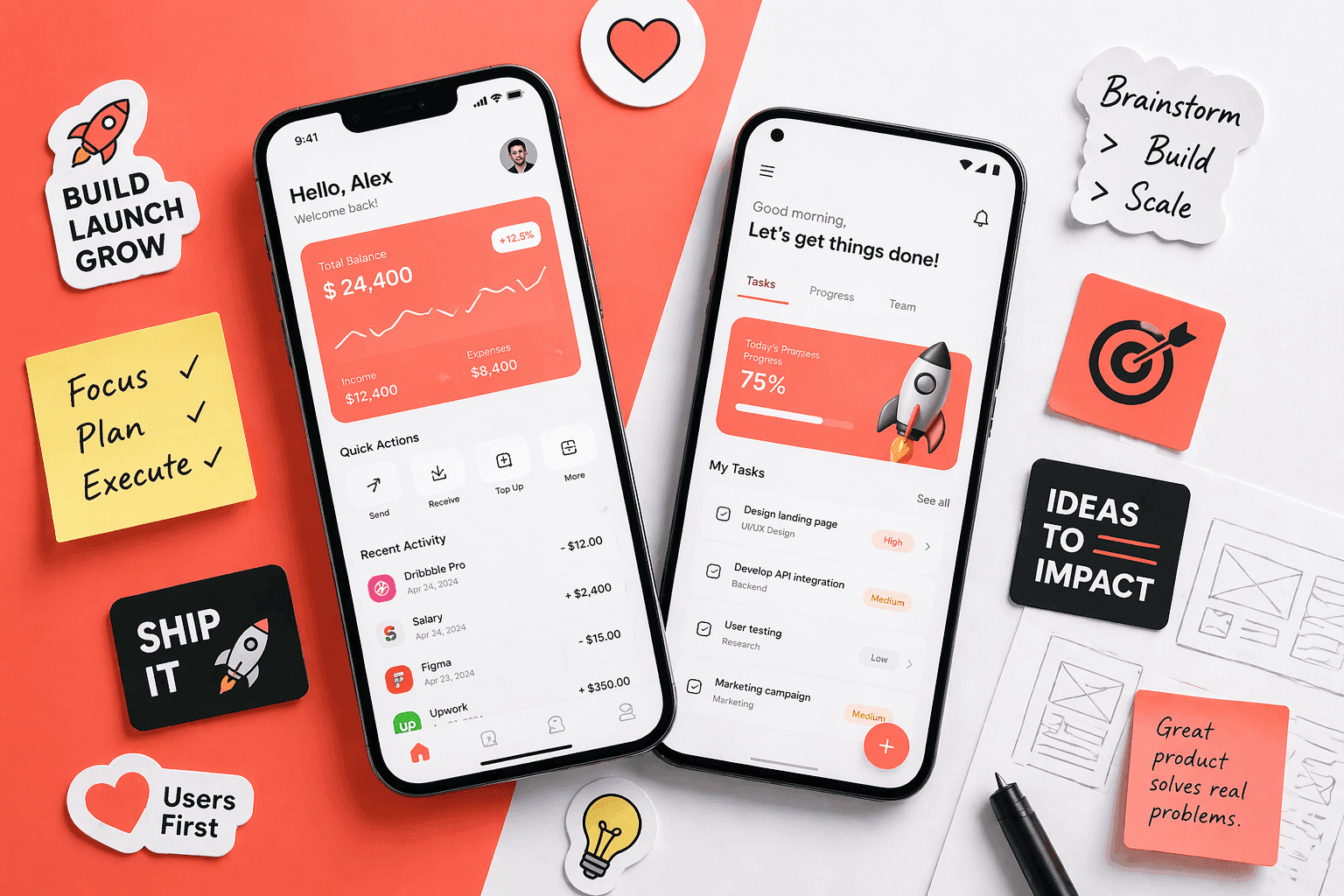
Building a mobile app for a startup is one of the most high-stakes product decisions a founding team makes. Done right, a mobile app can become your primary growth channel, your core product experience, and a significant competitive advantage. Done wrong, it becomes an expensive, slow-moving anchor that drains runway without delivering value.
This guide is for founders and product leaders making mobile development decisions - covering what to build first, how to structure your technology for growth, and the most common mistakes that cost startups time and money.
Should You Build a Mobile App First?
Not every product needs to start as a mobile app. Before committing to mobile development, answer these questions:
- Will your users primarily access this product on their phones? (Not just "could they" - will they?)
- Does a mobile app provide meaningfully better UX than a responsive web app for your core use case?
- Do you need device-specific features - camera, GPS, push notifications, biometrics - that are only practical in a native or hybrid app?
- Is your target user on iOS, Android, or both?
If mobile is clearly the right channel, proceed. If you are uncertain, a well-built responsive web application is often faster to validate, easier to iterate on, and lower risk for an early-stage product. You can always build the mobile app once the web product has found product-market fit.
Native vs. Cross-Platform: Making the Right Call for a Startup
For most startups, cross-platform development - using Flutter or React Native - is the right starting point. Here is why:
- One codebase, two platforms: You reach iOS and Android users without maintaining two separate codebases, two separate development teams, and two separate release cycles.
- Faster iteration: Changes ship to both platforms simultaneously. For a startup in rapid iteration mode, this is a significant advantage.
- Lower cost: One codebase means roughly half the development resources compared to building separate native apps.
The case for native development becomes compelling when you need deep platform-specific capabilities (complex hardware integrations, platform-specific UI patterns that cross-platform frameworks handle awkwardly), or when performance is a primary differentiator (gaming, AR/VR, real-time video processing).
For most startups building consumer or business apps - social features, booking flows, dashboards, content consumption, marketplace UX - cross-platform handles it well.
What to Build in Version 1
The most common mobile app mistake startups make is building too much in the first version. A v1 with 25 features is not more impressive than a v1 with 5. It is just more expensive, takes longer, and has more surfaces for bugs and UX problems.
Version 1 should cover:
- The core user journey - the single flow that delivers your primary value proposition
- Authentication (sign up, log in, account recovery)
- Essential notifications (push notifications for events that require timely user action)
- Crash-free, performant, stable fundamentals
Everything else - social features, advanced settings, secondary use cases, admin functionality - belongs in version 2 or later. The discipline required to keep v1 small is often the difference between startups that ship and ones that are still "in development" nine months later.
Getting the Architecture Right from the Start
Mobile architecture decisions made in the early days are expensive to undo later. Three architecture choices have the most long-term impact:
API Design
Your mobile app is a client of your backend API. The API design determines how easily you can add features, change data models, and support new platform capabilities. Build a clean, versioned REST (or GraphQL) API from the start - not endpoints tightly coupled to a specific mobile screen's data needs. A well-designed API also lets you add a web app later without rebuilding your backend.
State Management
How your app manages and shares data between screens matters significantly at scale. Choose a state management pattern appropriate for your team (in Flutter: Riverpod, Bloc; in React Native: Zustand, Redux Toolkit, React Query) and apply it consistently. Inconsistent state management in a growing codebase is one of the most common sources of bugs and development slowdowns.
Offline and Network Handling
Mobile networks are unreliable. A mobile app that crashes or loses data when connectivity drops is a poor product. Decide early how your app handles offline states: which features require connectivity, which can work offline, and how data is synchronised when connectivity is restored. Building this in later is significantly harder than designing for it from the start.
Performance Is a Feature
Mobile users are unforgiving about performance. Apps that launch slowly, scroll jerkily, or feel sluggish get deleted. A few non-negotiable performance standards for a production mobile app:
- Launch time: Cold launch under 3 seconds on mid-range devices. Warm launch under 1 second.
- Scroll performance: 60 FPS on list scrolling. No visible jank.
- Network responsiveness: Loading states for any operation over 500ms. Optimistic UI updates for common interactions.
- App size: Keep the initial download size minimal - large app sizes increase abandonment on the app store page before users even install.
What to Avoid: Common Startup Mobile Development Mistakes
- Building for the app stores before validating the idea: App store approval takes time. If your product concept is unvalidated, validate it with a web prototype first.
- Skipping UX design to save time: Apps that skip design work produce UX that users find confusing. Poor onboarding UX kills activation rates. Design is not optional.
- Treating push notifications as free marketing: Aggressive push notification strategies lead to users disabling notifications or deleting the app. Notifications should be high-value, timely, and relevant - not frequent.
- Ignoring app store optimisation (ASO): Your app's title, description, screenshots, and ratings significantly affect discoverability and conversion on the app stores. ASO is a real marketing channel.
- No analytics from day one: Without analytics, you are guessing about what users actually do in your app. Instrument the core flows from the start and make decisions based on real usage data.
Mobile App Development with Savyasachi Infotech
At Savyasachi Infotech, we design and develop high-performance mobile applications for startups and growing businesses using Flutter and React Native. We help founders make the right architecture decisions early, scope v1 tightly, design experiences that users actually enjoy, and ship to iOS and Android reliably.
From idea and UX design through development, testing, app store submission, and post-launch support - we handle the full mobile product lifecycle. Talk to our team about your mobile app project.
Planning for Post-Launch Iteration
The launch of your mobile app is the beginning of the product work, not the end. The most valuable thing a startup can do immediately after launching is establish a rapid feedback and iteration cycle. This means collecting crash reports and performance data automatically (via Firebase Crashlytics or Sentry), monitoring analytics for drop-off points in the core flow, and conducting brief user interviews with early adopters to understand what is working and what is not.
Plan your first post-launch iteration sprint before you launch. Having the team aligned on a two-week iteration cadence after launch - shipping bug fixes, small UX improvements, and the highest-priority missing features based on real user feedback - is what separates products that improve quickly from products that stagnate after the initial launch excitement. The startup that ships and iterates fastest learns fastest, which is the most durable competitive advantage available.
Let's Build Your Startup's Mobile App - Fast, Well, and Right
Your mobile app is often the first interaction a new user has with your product. That first experience determines whether they become a loyal customer or delete the app after three minutes. It deserves to be designed carefully and built with the right technical foundation from the start.
At Savyasachi Infotech, we design and develop mobile applications for startups and growth-stage businesses using Flutter and React Native. We help founders scope v1 tightly, design experiences users actually enjoy, and ship to iOS and Android with the architecture in place to support rapid iteration post-launch.
Book a free consultation and describe your app. We will advise on framework choice, scope, UX approach, and timeline - and give you an honest picture of what it takes to build a mobile product that actually retains users.