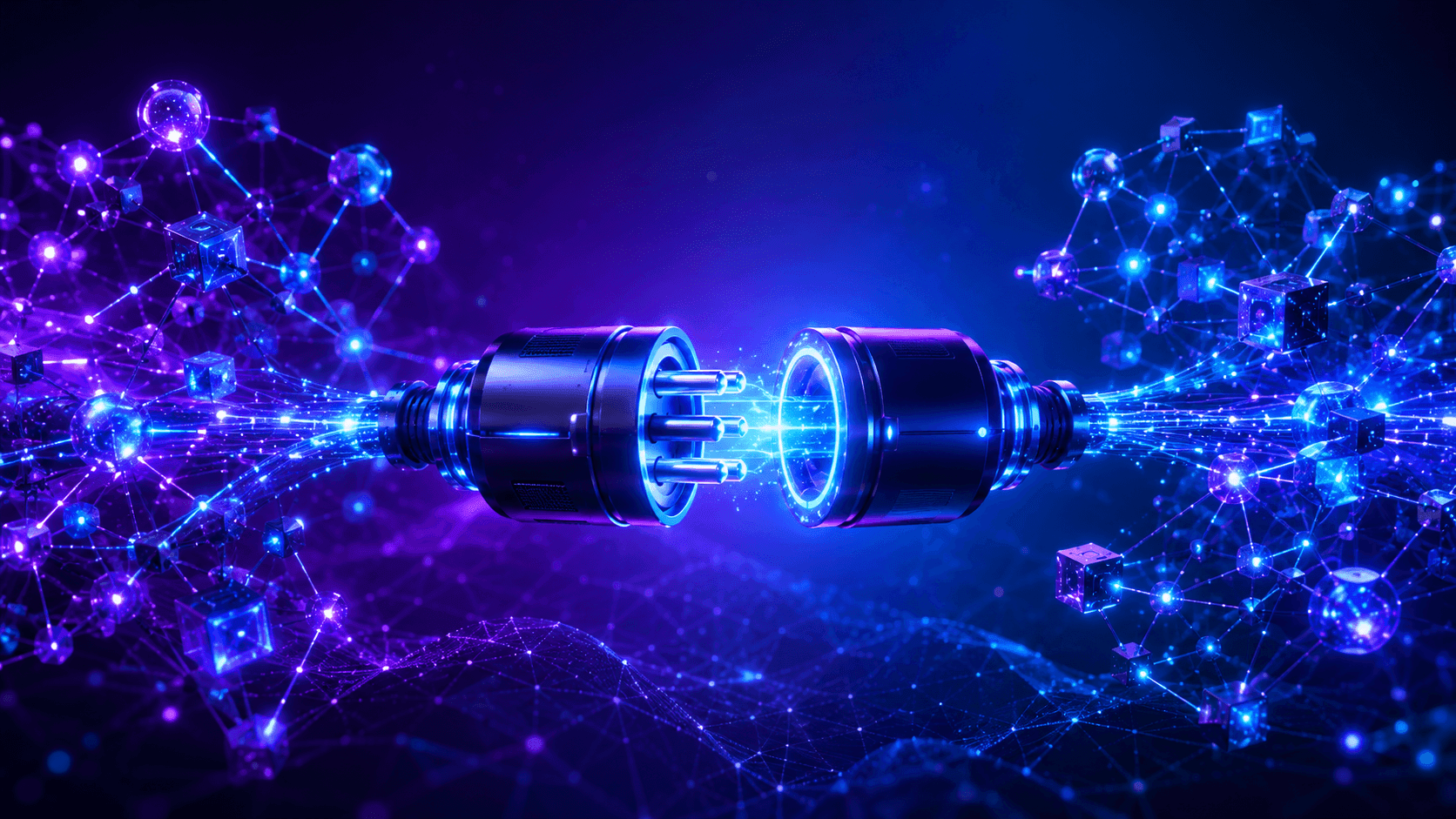
One of the most significant recent developments in AI infrastructure is the Model Context Protocol (MCP) - an open standard introduced by Anthropic that defines how AI models connect to external tools, data sources, and capabilities. In a field where every team was previously building its own tool integration layer from scratch, MCP establishes a shared protocol that is rapidly becoming the default approach.
This guide explains what MCP is, how it works architecturally, why it matters for AI development teams, and how to think about using it in production AI systems.
What Is MCP?
Model Context Protocol is an open protocol that standardises the way AI models interact with external resources - databases, APIs, file systems, web services, and any other tool a model might need to access during task execution. Before MCP, each AI application team built its own function-calling or tool-use layer, with no standardisation across implementations.
MCP solves this by defining a consistent communication interface between AI models (the "clients") and the tools and data sources they connect to (the "servers"). Any AI client that supports MCP can connect to any MCP-compatible server - similar to how a web browser can access any website that uses HTTP, regardless of what technology the website is built with.
The Architecture: Clients, Servers, and the Protocol
The MCP architecture has three main components:
MCP Hosts
The AI application that wants to use external tools and data. This could be a conversational AI assistant, an AI agent workflow, a coding assistant, or any other LLM-powered system. The host initiates connections to MCP servers and routes tool requests through the protocol.
MCP Servers
Lightweight servers that expose specific capabilities - a database interface, a web search tool, a file system reader, a CRM integration, a code execution environment. Each MCP server defines the tools and resources it exposes, and handles requests from the host to use those tools. Servers can be local (running on the same machine) or remote (accessed over a network).
The Protocol
MCP uses JSON-RPC 2.0 as its transport layer. The protocol defines three types of capabilities that servers can expose: Tools (functions the model can call to take actions - read a file, send a message, query a database), Resources (data sources the model can read - documents, database contents, API responses), and Prompts (pre-defined prompt templates the model can use for specific tasks).
Why MCP Matters for AI Development
Interoperability Across Systems
With MCP, an AI agent built with any supporting framework can connect to any MCP-compatible tool server. If you have built an MCP server for your internal CRM, it can be used by your customer support agent, your sales analysis agent, and your reporting agent - without rebuilding the integration for each one. This reusability fundamentally changes the economics of AI integration work.
Ecosystem Effects
Because MCP is an open standard, a growing ecosystem of pre-built MCP servers is emerging - for popular databases, web search, file systems, APIs, and developer tools. Rather than building every integration from scratch, teams can start with community-maintained servers and focus their engineering effort on their specific business logic.
Security and Permission Scoping
MCP provides a structured way to scope what tools an AI agent can access. Each server explicitly defines its capabilities, and the host controls which servers the agent connects to. This gives development teams fine-grained control over what an AI agent can do - essential for production deployments where unscoped tool access is a security risk.
Separation of Concerns
MCP cleanly separates the AI reasoning layer from the tool and data integration layer. Teams that specialise in AI can build agent logic without needing deep knowledge of every system the agent touches. Teams that specialise in systems integration can build MCP servers for the tools they manage without needing to understand AI model internals. Each layer can evolve independently.
MCP in Practice: What Building with It Looks Like
A typical MCP-based AI system is assembled as follows:
- Define the tools your agent needs - database queries, API calls, file operations, web search.
- Build (or use existing) MCP servers that expose those tools with appropriate authentication and permission scoping.
- Configure the AI host to connect to the relevant MCP servers.
- The model, when executing a task, can discover available tools through the protocol and call them as needed - the orchestration layer routes tool calls to the correct server and returns results to the model.
The development experience is significantly cleaner than building custom tool integration pipelines for each agent. The protocol handles the communication contract; the team handles the business logic.
Current Adoption and Tooling
Claude (Anthropic's AI model) has first-class MCP support. Claude Desktop, Claude Code, and the Claude API all support MCP connections. Other AI frameworks and models are adding MCP support, and the ecosystem of MCP-compatible tools and servers is growing rapidly through open-source contributions.
For development teams building AI agents today, MCP is worth understanding and evaluating - not because it solves every tool integration problem, but because it is becoming the shared infrastructure layer that reduces duplication of effort across the AI development community.
Considerations for Production Deployment
While MCP significantly simplifies tool integration, production deployments need careful thought around several concerns:
- Authentication: Remote MCP servers require secure authentication. Design your server authentication model carefully before exposing sensitive tools.
- Rate limiting and cost control: Each tool call initiated by an agent via MCP consumes resources. Implement rate limiting and monitoring on servers that call paid external APIs.
- Error handling: AI agents calling tools via MCP need robust handling for server errors, timeouts, and unexpected responses. Design both the server and the agent to fail gracefully.
- Logging and auditability: Every tool call via MCP should be logged for debugging and compliance. This is especially important in enterprise environments where agent actions need to be auditable.
Building MCP-Based AI Systems with Savyasachi Infotech
At Savyasachi Infotech, we design and develop AI agent systems using modern infrastructure including MCP for tool integration. We build custom MCP servers for client-specific data sources and tools, architect agent orchestration systems that use MCP for clean separation of concerns, and deploy production-ready agentic AI solutions on AWS, Google Cloud, and Azure.
If you are building AI agents that need to connect to your internal systems and data, talk to our team about the right architecture for your use case.
The Broader Significance of Protocol Standardisation
MCP is one example of a broader pattern happening in AI infrastructure: the maturation from bespoke, one-off integrations to standardised protocols and shared infrastructure. This pattern - where an ecosystem of interoperable components replaces a fragmented landscape of custom implementations - is what enables the AI development field to build on accumulated progress rather than reinventing foundational pieces for every project.
Teams that adopt well-designed standards early gain compounding benefits over time: smaller integration surface area, easier access to ecosystem improvements, and the ability to focus engineering effort on differentiated business logic rather than plumbing. MCP is young but its trajectory suggests it will be foundational AI infrastructure within a few years - which makes understanding it now a worthwhile investment for any team building production AI systems.
Building AI Agents That Need to Connect to Your Systems?
Connecting AI agents to real business data and tools - your CRM, your database, your internal APIs - is where the real value of AI automation gets unlocked. The architecture you use for these integrations determines how maintainable, secure, and scalable your AI system will be in production.
At Savyasachi Infotech, we build production AI agent systems with clean tool integration architecture - including MCP-based integrations for teams that need interoperable, well-structured tool access layers. We handle the full stack: model selection, orchestration, tool integration, security, and cloud deployment.
Book a free consultation and describe what systems your AI agents need to access. We will design the right integration architecture for your environment and requirements.